
Fixed price vs time and materials: MVP guide
fixed price vs time and materials compared for MVPs: budget risk, scope control, timelines, and when each contract fits.
Build My App Fast · Nov 24, 2026 · 12 min read
fixed price vs time and materials is a tradeoff between certainty and flexibility. Fixed price gives a founder a defined scope, defined cost, and defined delivery window. Time-and-materials gives the team room to explore, change direction, and bill for the actual hours and tools used. For most first MVPs, fixed price works better when the goal is to ship a narrow product quickly. Time-and-materials works better when the work is open-ended, research-heavy, or likely to change every week.
This is not a moral choice. Both models can be used well, and both can be abused. The contract model should match the stage of the product, the clarity of the scope, and how much budget risk the founder can carry.
At Build My App Fast, we use fixed-price, fixed-timeline packages because early-stage founders usually need a working app, not an open tab. But there are cases where time-and-materials is the more honest model. The key is knowing which situation you are in before signing.
Fixed price vs time and materials: the short version

Here is the practical comparison for a founder deciding how to build an MVP, internal tool, customer portal, or first SaaS product.
| Question | Fixed price | Time-and-materials |
|---|---|---|
| What do you pay for? | A defined outcome or scope | Actual time spent plus agreed expenses |
| Budget certainty | High if scope is controlled | Low to medium; depends on pace and changes |
| Timeline certainty | Higher when the scope is narrow | Depends on team availability and evolving priorities |
| Best for | MVPs, prototypes, defined builds, launch sprints | Discovery, complex rebuilds, ongoing product teams |
| Main founder risk | Mis-scoping the project upfront | Cost drift and endless iteration |
| Main developer risk | Underestimating the work | Being judged on hours instead of outcomes |
| Change requests | Usually priced separately or swapped against scope | Usually accepted and billed as more time |
| What must be clear upfront? | Features, user roles, integrations, acceptance criteria | Priorities, budget cap, reporting rhythm, decision-maker |
If you can describe the first useful version of the product in a one-page brief, fixed price is often the cleaner model. If you are still discovering what the product is, time-and-materials can be safer because pretending uncertainty is fixed does not make it disappear.
For a broader pricing comparison, see our guide to MVP pricing models.
What fixed price really means
A fixed-price contract says: for this scope, on this timeline, the price is this number.
That does not mean every possible idea is included. A serious fixed-price agreement should define what is in scope, what is out of scope, what counts as done, and what happens when the founder changes direction.
For example, “build a SaaS app” is not a fixed-price scope. It is a category. A fixed-price scope sounds more like:
- Magic-link authentication
- One admin role and one customer role
- Customer dashboard with a list/detail workflow
- Supabase database with specific tables
- Stripe Checkout for one subscription product
- Resend transactional emails for account events
- Deployment to Vercel
That level of clarity gives the development team enough information to estimate the build. It also protects the founder from paying for vague effort.
Fixed price works best when the vendor has built similar patterns before. A team that already knows Next.js, React, Supabase, Stripe, Tailwind, Resend, and Vercel can estimate common MVP patterns more accurately than a team learning the stack during the project.
It also works best when the founder accepts a basic rule: fixed price buys focus. If the scope changes daily, the contract has to change too.
What time-and-materials really means
A time-and-materials contract says: the team will work on your product, track time, and bill for the time and agreed costs used.
The “materials” part can include software subscriptions, infrastructure, paid APIs, design assets, testing tools, or other project costs. In software projects, the largest cost is usually the labor, not literal materials.
This model is common when the destination is not fully known. Examples:
- You are replacing a legacy system and do not know every workflow yet.
- You need technical discovery before committing to architecture.
- You are testing several product directions in parallel.
- You have an existing app with unclear bugs and no clean documentation.
- You want a team to behave like an ongoing product department.
Time-and-materials can be fair and transparent when it is managed well. The founder sees what the team is doing, can change priorities, and does not need to negotiate a new contract for every adjustment.
The downside is obvious: the meter is always running. If the project lacks a strict budget cap, weekly demos, and a decisive owner, it can turn into a long sequence of “almost there” work.
Why fixed price works well for first MVPs
Most first MVPs do not need unlimited flexibility. They need constraint.
The purpose of an MVP is to test whether a specific user will use or pay for a specific workflow. That requires enough product quality to be credible, but not every feature the founder can imagine.
A fixed-price MVP contract forces three useful conversations before code starts:
- Who is the first user?
- What is the core workflow?
- What can wait until after launch?
Those questions prevent a common early mistake: turning a validation build into a full product roadmap. If you need help narrowing the first version, read how to scope an MVP before asking for quotes.
Fixed price is especially useful when the product fits known patterns:
- Login and user accounts
- Simple dashboards
- CRUD workflows
- Admin panels
- File uploads
- Subscription payments
- Transactional email
- Basic AI-assisted workflows
- Lightweight integrations
These are not “easy” in the sense that anyone should ship them carelessly. Payments, permissions, and database rules still need real engineering. But they are known enough that an experienced team can define a fixed build.
For example, adding Stripe is not just a button. You need to think through checkout, customer records, subscription state, webhook handling, and failure cases. Stripe’s own webhooks documentation shows why payment events need deliberate handling rather than guesswork.
Where time-and-materials is the better fit
Time-and-materials is often the better model when the project contains major unknowns that cannot be responsibly estimated.
A few examples:
- You have an existing codebase and nobody knows its condition.
- You need to integrate with a poorly documented third-party system.
- You are doing machine learning or AI experimentation where the output quality is uncertain.
- The product depends on stakeholder review cycles you do not control.
- You expect priorities to change weekly based on customer research.
- You need ongoing feature development after launch.
In those cases, a fixed bid can create bad incentives. The vendor may add a large risk buffer, cut corners to protect margin, or fight every change request. The founder may feel protected by the quote until the team says, reasonably, “that was not included.”
A well-run time-and-materials project should still have controls:
- Weekly budget visibility
- A maximum spend threshold
- Short milestones
- Working demos, not just status updates
- A single founder-side decision-maker
- Clear rules for pausing or reprioritizing work
Without those controls, time-and-materials becomes open-ended development with polite invoices.
The real issue: who carries the risk?
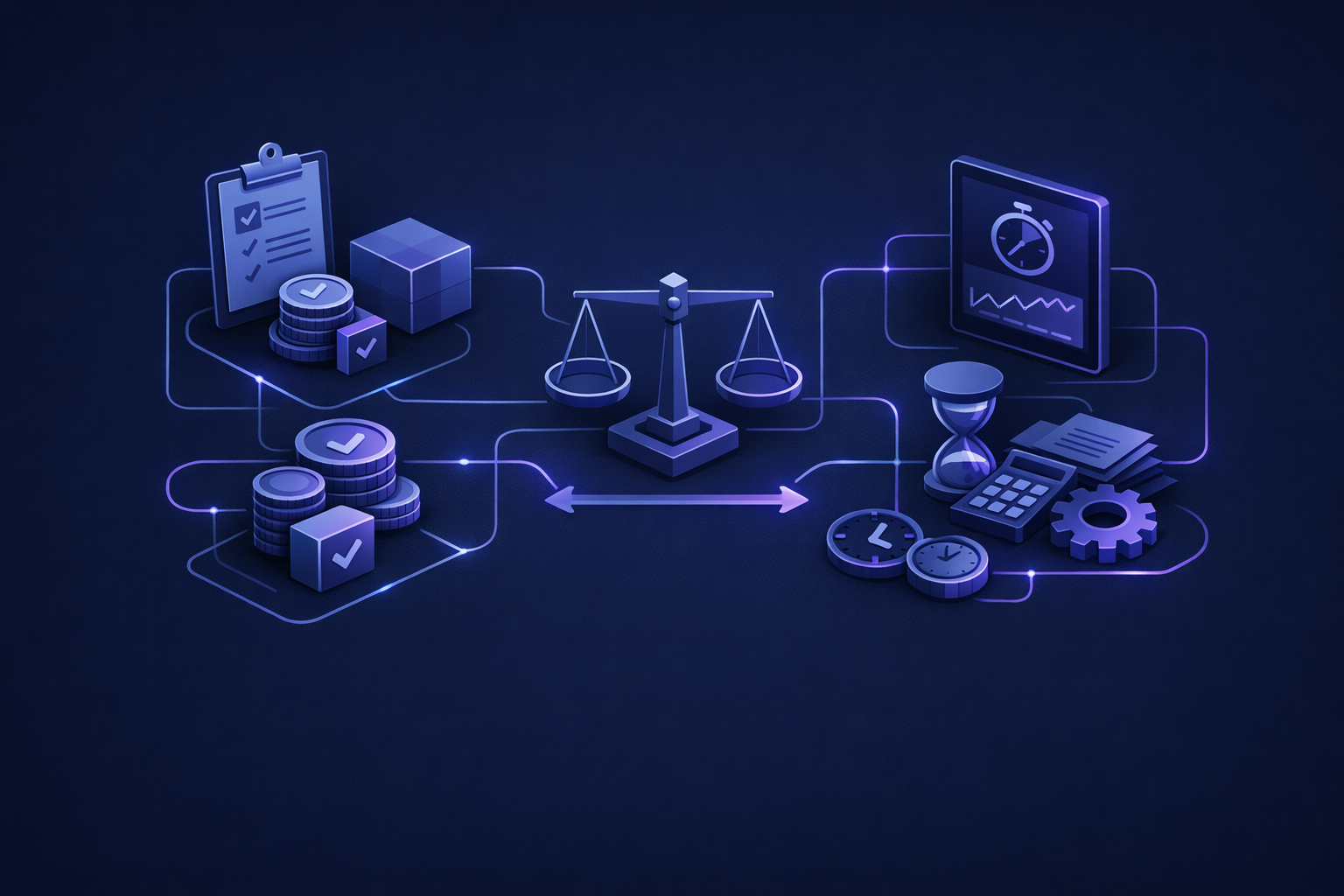
The contract model decides where the risk sits.
With fixed price, the development team carries more estimation risk. If they underestimate a defined scope, they absorb the extra effort. That is why competent fixed-price teams are strict about scope. They have to be.
With time-and-materials, the founder carries more budget risk. If the team underestimated, discovered complexity, or moved slowly, the invoice still reflects the time spent. That can be fair, but it must be visible.
Neither model removes risk. It only moves it.
The founder’s job is to choose the risk they can manage:
- If budget certainty matters most, choose fixed price and keep scope tight.
- If discovery matters most, choose time-and-materials and cap the spend.
- If speed matters most, choose a fixed timeline with ruthless feature selection.
- If quality matters most, make acceptance criteria explicit in either model.
We have written separately about why fixed timeline development is often more useful than an open-ended build for early products. Timeline pressure is not about rushing. It is about forcing decisions.
How fixed-price projects go wrong
Fixed price fails when the scope is vague but the expectations are broad.
Bad fixed-price scope sounds like:
- “Build a marketplace like Airbnb.”
- “Create a dashboard for all our operations.”
- “Make an AI assistant for our customers.”
- “Build the app and we will explain as we go.”
Those statements may be fine as vision, but they are not build instructions.
Fixed-price projects also go wrong when founders assume the vendor will include every small idea because “it should be simple.” Small changes can be simple in isolation and still expensive in combination. A new role, permission rule, billing edge case, or notification type can affect database design, UI states, background jobs, tests, and deployment settings.
This is why the best fixed-price contracts define acceptance criteria. For example:
- A user can sign in with a magic link.
- A subscribed user can access the dashboard.
- A non-subscribed user is redirected to the billing page.
- An admin can update customer status.
- A webhook updates subscription state in the database.
Those criteria make the project testable. They also reduce subjective arguments near the finish line.
If you have seen quotes triple after kickoff, the issue was often not “developers are bad.” It was usually a mismatch between vague scope and fixed-price expectations. We cover that pattern in why MVP cost overruns happen.
How time-and-materials projects go wrong
Time-and-materials fails when nobody owns the finish line.
Because changes are easy to request, the project can accumulate half-finished work. A founder asks for a new dashboard view. Then a new onboarding flow. Then a different pricing model. Then an integration. Each decision may be reasonable, but the product never reaches a clean launch state.
The other problem is false precision. Hourly reports can look detailed while still failing to answer the only question that matters: are we closer to a usable product?
A healthy time-and-materials engagement should show progress in working software. Not slides. Not long explanations. Software.
If you choose T&M, ask for:
- A weekly demo link
- A weekly spend summary
- A prioritized backlog
- A written definition of done for the current milestone
- A stop/go decision point before the next block of work
That structure keeps flexibility from becoming drift.
How Build My App Fast approaches fixed-price work
Our model is intentionally fixed because most founders who come to us are not trying to staff a software department. They want a production-ready first version built by engineers who know the stack and can ship quickly.
Our tiers are:
- $1,000 "Proof of concept" — proof of concept, delivered in 2–4 days
- $5,000 "Real app" — full app with logins and a database, delivered in 4–6 days
- $10,000 "Launchable MVP" — advanced MVP with subscriptions, integrations, or AI features, delivered in 7–10 days
The stack is practical: Next.js, React, Supabase, Stripe, Tailwind, Resend, and Vercel. We use it because it covers the common needs of modern SaaS and internal products without forcing a custom infrastructure project too early.
A typical fixed-price process looks like this:
- Clarify the product goal and first user.
- Cut the scope to the smallest useful version.
- Confirm the tier and delivery window.
- Build the working app.
- Show working software before final payment.
- Hand over the code with full ownership.
That last part matters. A fixed-price MVP should not trap you. You should own the code, understand what was built, and be able to continue with us, another team, or your own future hires.
For database-backed apps, we also care about permissions early. Supabase makes it possible to use Postgres Row Level Security, but it still has to be designed correctly. The official Supabase Row Level Security docs are a good reference for why auth and data access rules are not an afterthought.
Decision checklist
Use this checklist before choosing fixed price vs time-and-materials:
- Can you describe the first version in one page?
- Do you know the user roles?
- Do you know the core workflow?
- Are the integrations known and documented?
- Can you name what is out of scope?
- Do you need budget certainty more than flexibility?
- Can one person make product decisions quickly?
- Will you accept tradeoffs to hit the launch date?
If you checked most of those, fixed price is probably a good fit. If you left most blank, start with discovery, a prototype, or a time-capped T&M phase.
The mistake is not choosing one model over the other. The mistake is choosing a model that does not match your uncertainty.
FAQ
Is fixed price cheaper than time-and-materials?
Not always. Fixed price is more predictable, not automatically cheaper. A good vendor may include risk in the quote because they are committing to an outcome. Time-and-materials can be cheaper for a small, clear task, but it can become expensive when priorities change or the project lacks a stopping point.
Can I change scope in a fixed-price contract?
Yes, but the contract should explain how. The cleanest options are a paid change request, a scope swap, or pushing the new feature to a later phase. If every change is treated as included, the project stops being fixed price in any meaningful sense.
When should a founder avoid fixed price?
Avoid fixed price when the codebase is unknown, the technical approach is experimental, or the product direction is still changing weekly. In those cases, use a short discovery phase or a capped time-and-materials engagement before asking for a fixed build quote.
What should be included in a fixed-price MVP contract?
At minimum: scope, exclusions, timeline, payment schedule, ownership terms, acceptance criteria, deployment expectations, and change request rules. If the contract avoids those details, the fixed price may not protect you as much as it appears.
If you want a fixed-price MVP with a defined scope, delivery window, and full code ownership, apply to work with Build My App Fast.