Vibe Coding for Founders: Where It Wins and Fails
vibe coding for founders is useful for prototypes, but risky for production. Here is where it helps, fails, and how to ship safely.
Build My App Fast · Sep 26, 2026 · 13 min read
vibe coding for founders is best for turning a rough idea into a clickable prototype fast. It is not a reliable substitute for production engineering once your app needs authentication, payments, database permissions, security, emails, admin tools, or supportable code. Used correctly, it can help you think, test, and communicate. Used as a shortcut to launch, it often creates fragile software that looks finished before it is actually safe to use.
That distinction matters because founders are not wrong to be excited. Modern AI coding tools can create screens, connect APIs, generate database schemas, and explain code in plain English. For a non-technical founder, that is a real shift. The problem is that software does not fail only where you can see it. It fails in edge cases, permissions, retries, payment states, account recovery, deployment settings, data leakage, observability, and code paths nobody tested.
This post is a practical founder guide: where vibe coding genuinely helps, where it tends to break down, and how to decide whether to keep iterating yourself or bring in engineers.
Vibe coding for founders: what it is actually good at
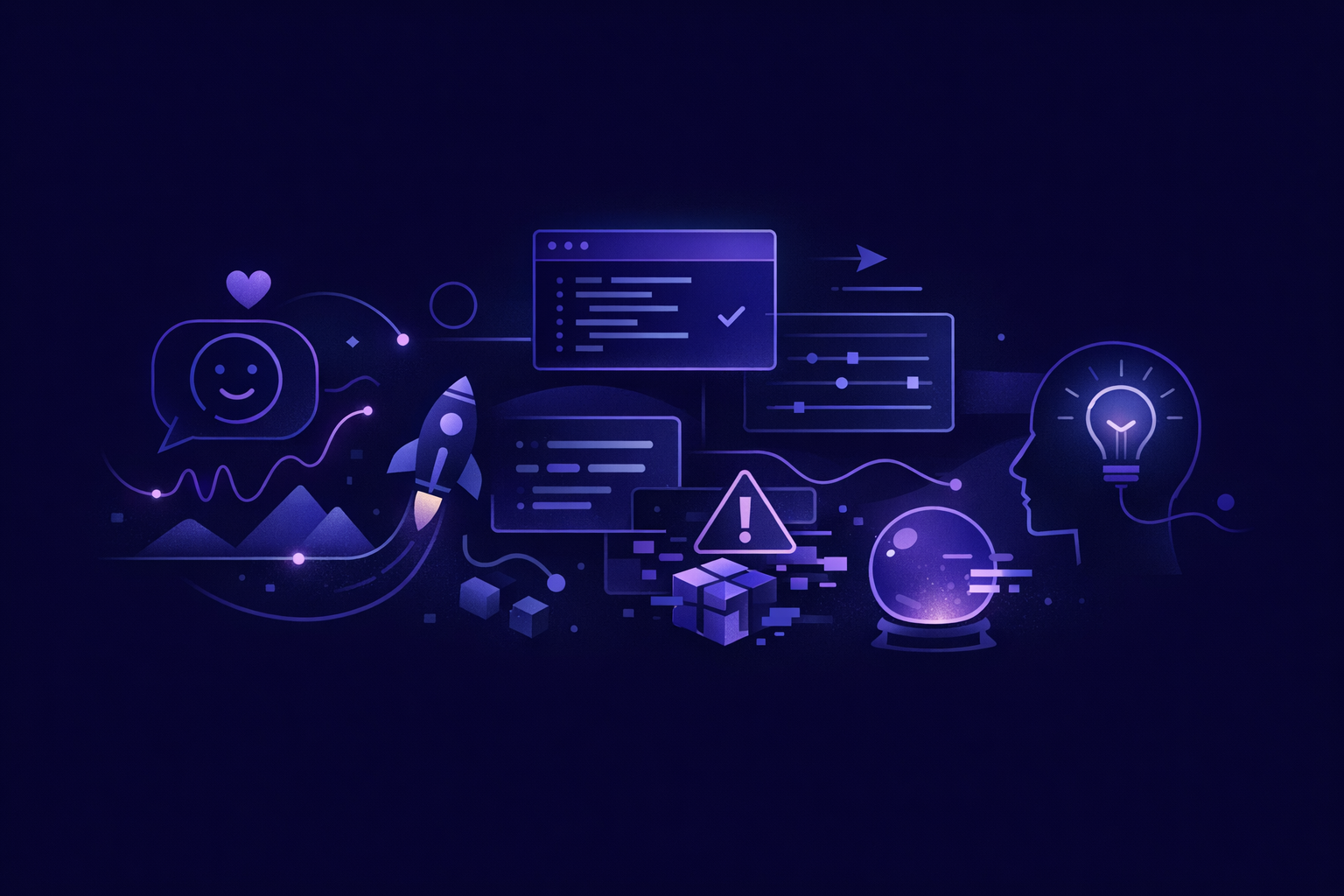
Vibe coding is strongest when the cost of being wrong is low. That usually means pre-launch exploration, internal demos, throwaway prototypes, and founder learning.
A good use case is: “I want to see whether this workflow makes sense before I pay anyone to build it properly.” A risky use case is: “I want strangers to enter payment details and sensitive business data into this AI-generated app next week.”
Here is where vibe coding works well.
1. Making vague ideas concrete
Most product ideas start too abstract: “a CRM for local service businesses,” “an AI onboarding tool,” “a dashboard for agency reporting.” The first useful step is not always engineering. It is making the workflow visible.
AI coding tools can quickly produce:
- A landing page
- A dashboard layout
- A form flow
- A fake data table
- A basic settings screen
- A clickable demo for investors or early users
That helps you stop debating imaginary features. You can point to a screen and say, “This is what I mean.” For founders, that clarity is valuable.
2. Learning enough to talk to developers
Non-technical founders often struggle because they do not know what to ask for. Vibe coding can make you more fluent. You start seeing the difference between frontend components, database tables, authentication, API routes, environment variables, and deployment.
That does not make you a senior engineer. It does make you a better client, buyer, or product owner.
If you are still shaping the product, pairing vibe coding with a simple written scope is useful. A one-page spec beats a messy prompt history every time. We covered that in more detail in our guide to writing an MVP spec that prevents misbuilds.
3. Testing interface ideas before committing budget
If you are deciding between three onboarding flows, vibe coding can help you mock all three. If you are unsure whether users need a kanban board, table view, or chat interface, you can generate rough versions and ask prospects which one they understand fastest.
This is a smart use of the technology because the prototype is being used to reduce uncertainty, not to pretend the app is finished.
4. Creating a better handoff for engineers
A founder who brings engineers a working-ish prototype, a clear product brief, and a prioritized feature list is much easier to help than a founder with only a paragraph of ideas.
The key phrase is “working-ish.” The prototype is evidence of intent. It is not automatically the foundation of the production app.
Sometimes we can reuse concepts, copy, layouts, and logic from a vibe-coded prototype. Sometimes the safest path is to rebuild the core properly in Next.js, React, Supabase, Stripe, Tailwind, Resend, and Vercel. The decision depends on code quality, data model, auth design, and what the app must do after launch.
Where vibe coding starts to fail
The uncomfortable truth: vibe coding often fails at the exact moment the app starts to matter.
A prototype can survive happy-path demos. A production app has to survive confused users, expired sessions, failed payments, partial signups, duplicate submissions, password resets, bad network conditions, webhook delays, permission mistakes, browser differences, and future feature changes.
Here are the common failure points.
1. Authentication that works but is not designed
Login is easy to demo and hard to finish.
A generated app may appear to support sign-up and sign-in, but production auth also requires decisions about:
- Email verification
- Password reset
- Session handling
- Protected routes
- Role-based access
- Team accounts
- Account deletion
- Admin access
- User data isolation
If the tool wires auth incorrectly, users may access screens they should not see. Worse, they may access data they should not see.
Supabase is a strong choice for many MVPs, but its security model depends on understanding Row Level Security. The official Supabase docs are clear that Row Level Security should be enabled and controlled with policies. AI-generated code can create tables quickly; it does not always create the correct policies for your business rules.
2. Database design that paints you into a corner
Vibe-coded apps often create whatever schema satisfies the current prompt. That can be fine for a demo. It becomes expensive when you need to add billing, teams, audit logs, ownership, permissions, or reporting.
Bad database design shows up later as:
- Duplicated records
- Missing relationships
- Confusing user ownership
- Slow queries
- Painful migrations
- Data that cannot be trusted
- Features that require rewriting core tables
The problem is not that AI cannot generate SQL. It can. The problem is that database design is partly product strategy. If your app will eventually support teams, subscriptions, admin review, invitations, or usage limits, those assumptions need to be reflected early.
3. Payments that look done but are not complete
Payments are one of the most dangerous areas to vibe code casually.
A checkout button is not the same as a billing system. A production subscription flow may need:
- Checkout sessions
- Customer records
- Webhooks
- Subscription states
- Cancellations
- Failed payment handling
- Plan changes
- Trial logic
- Invoice history
- Access control tied to billing status
Stripe has excellent docs, including guidance for building and testing subscriptions. The hard part is not copying a snippet. It is making sure your app behaves correctly when payment events happen out of order, fail, or change later.
If revenue depends on the app, payments should be engineered and tested, not guessed into place.
4. Security holes that are invisible in the UI
A vibe-coded app can look polished while exposing private data behind the scenes. Founders usually inspect screens. Attackers inspect requests, tokens, permissions, storage buckets, API routes, and database rules.
Common issues include:
- Public API keys used incorrectly
- Server-only logic exposed to the browser
- Missing authorization checks
- Overly broad database permissions
- Insecure file uploads
- Leaked environment variables
- Admin routes protected only by hidden navigation
- User IDs trusted from the client
This is why “it works on my screen” is not a launch standard. If you plan to ship AI-generated code, run it through a real review. Our audit AI generated code guide explains what to inspect before real users touch it.
5. No clear path from prototype to maintained product
Production software changes. You will add features, fix bugs, support users, update dependencies, improve onboarding, and adjust pricing.
Vibe-coded projects often become hard to maintain because they lack:
- Consistent file structure
- Clear naming
- Shared patterns
- Tests or testable boundaries
- Error handling
- Logging
- Documentation
- Separation between demo code and real business logic
The first version may feel fast. The second version may be slow. The third version may require a rebuild.
That does not mean vibe coding is useless. It means founders should treat it as a phase, not a permanent engineering strategy.
A practical decision table
Use this table to decide whether vibe coding is enough for the current stage.
| Situation | Vibe coding is a good fit? | Why |
|---|---|---|
| Landing page mockup | Yes | Low risk, easy to inspect, fast to revise |
| Clickable product demo | Yes | Useful for feedback before engineering spend |
| Internal workflow prototype | Usually | Safe if no sensitive data or real customers depend on it |
| Waitlist with basic form | Maybe | Fine if data handling and email capture are simple |
| App with user accounts | Risky | Auth, sessions, and permissions need careful implementation |
| App with customer data | Risky | Privacy and data isolation must be verified |
| Subscription SaaS | Usually no | Stripe, webhooks, access control, and billing states must be correct |
| Marketplace or multi-tenant app | No | Roles, ownership, permissions, and edge cases are core architecture |
| Regulated or sensitive data product | No | Security, compliance, and auditability matter from day one |
A simple rule: the more your app touches money, private data, or user permissions, the less you should rely on unreviewed generated code.
The founder workflow that actually works
The best founder workflow is not “AI or developers.” It is using each where it is strongest.
Step 1: Use vibe coding to explore
Prompt your way into a rough version. Try the dashboard. Try onboarding. Try the empty states. Try the admin view. Build the thing badly enough to understand the thing better.
At this stage, do not obsess over perfect code. Obsess over product clarity.
Ask:
- What is the core job this app performs?
- What does the user do first?
- What information must be stored?
- What actions must be restricted?
- What must happen when something fails?
- What can be removed from version one?
Step 2: Write the product brief
Once the prototype helps you think, turn it into a brief. Screenshots are useful, but they are not enough.
Your brief should include:
- Target user
- Main problem
- Core workflow
- Must-have features
- Explicit non-features
- Data that must be stored
- User roles
- Payment requirements
- Integrations
- Launch deadline
This is where many founders avoid hard choices. Do not. Scope discipline is what makes a fast build possible.
Step 3: Decide what deserves production engineering
Not every idea deserves a $10,000 MVP. Some deserve a $1,000 proof of concept. Some deserve more customer interviews and no code at all.
At Build My App Fast, we use fixed tiers because founders need clarity before committing:
- $1,000 “Proof of concept” — proof of concept, delivered in 2–4 days
- $5,000 “Real app” — full app with logins and a database, delivered in 4–6 days
- $10,000 “Launchable MVP” — advanced MVP with subscriptions, integrations, or AI features, delivered in 7–10 days
The point is not to make every project bigger. It is to match the build to the risk. If you only need to prove a workflow, a proof of concept may be enough. If users need accounts and stored data, you need a real app. If billing, integrations, or AI features are central, you need a launchable MVP with proper architecture.
For a broader comparison of when AI tools and engineers each make sense, see our post on vibe coding vs developers.
What production-ready means in this context
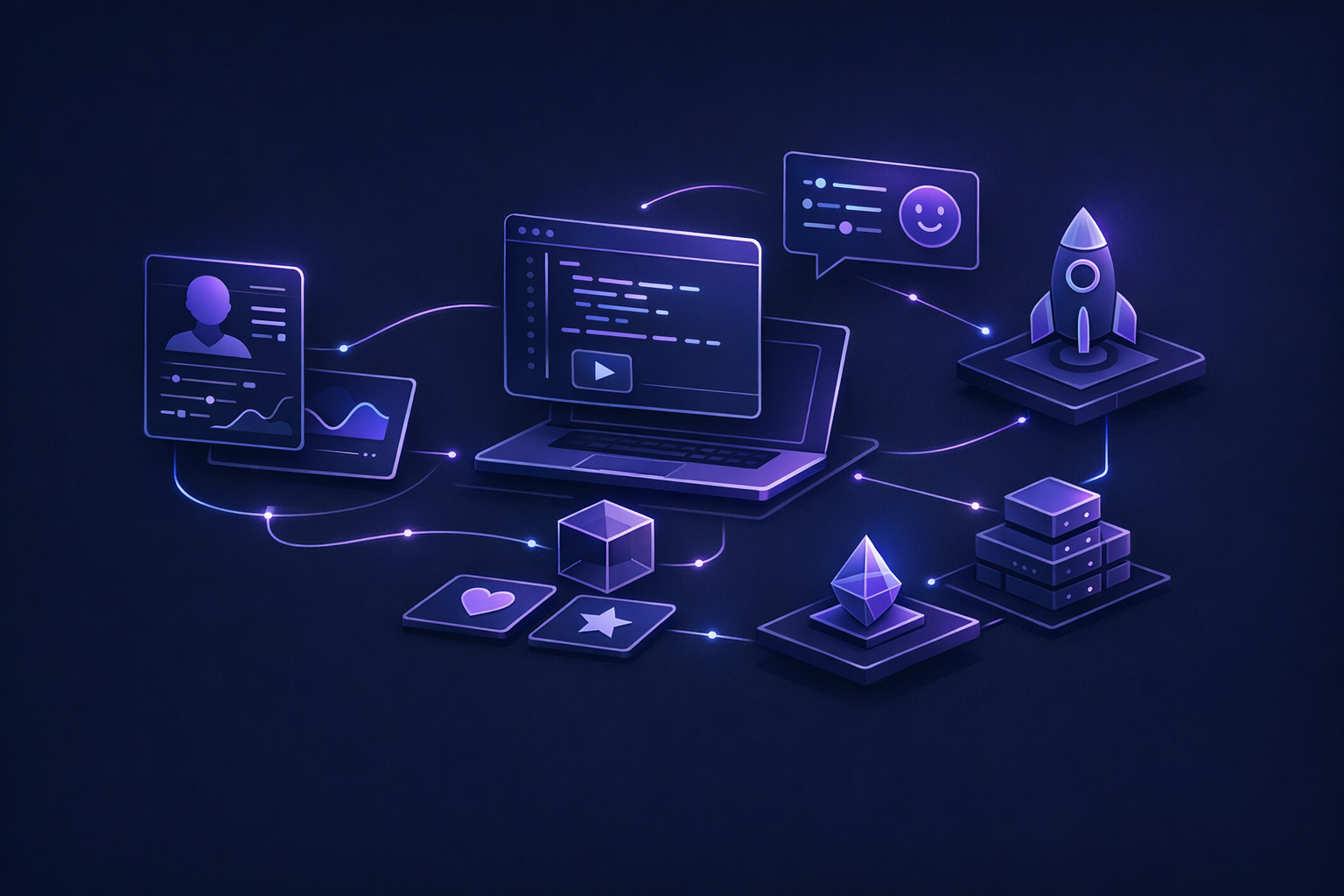
Production-ready does not mean enterprise-perfect. It means the app is built with enough discipline that real users can use it without the founder holding everything together manually.
For a modern SaaS-style MVP, that usually includes:
- Next.js application structure
- React components that are maintainable
- Supabase auth and database configured intentionally
- Row Level Security policies for user data
- Stripe payments if the product charges customers
- Resend transactional emails for key flows
- Tailwind UI that can be extended
- Vercel deployment with environment variables handled properly
- Basic loading, error, and empty states
- Clear ownership of the codebase
This is the gap between “demo” and “app.” It is also where many vibe-coded projects stall.
We are not anti-AI. We use AI where it helps. But production work still needs engineering judgment: what to accept, what to rewrite, what to test, and what to refuse.
If you already have a vibe-coded project and want to understand the path forward, our vibe code to production checklist is the next useful read.
Signs you should stop vibe coding and bring in engineers
There is no shame in using AI tools aggressively. The mistake is ignoring the point where the risk changes.
You should bring in engineers when:
- Users will create accounts
- Customers will pay through the app
- Private data will be stored
- Teams or roles are involved
- The app needs admin tools
- You need reliable email flows
- The app uses AI outputs in a customer-facing workflow
- You are afraid to touch the code because one change breaks another
- You cannot explain the database schema
- You do not know whether users can access each other’s data
The last two are especially important. If you cannot explain who can read and write each table, you are not ready to launch.
FAQ
Can a non-technical founder launch with vibe coding?
Sometimes, but it depends on what “launch” means. A public demo, waitlist, or internal prototype is realistic. A paid SaaS with auth, subscriptions, customer data, and support obligations should be reviewed or rebuilt by engineers before launch.
Should I throw away my vibe-coded prototype?
Not automatically. The prototype may contain useful product decisions, copy, layouts, and workflow ideas. The code may or may not be reusable. A technical review should decide which parts are safe to keep and which parts should be rebuilt.
Is vibe coding cheaper than hiring developers?
For early exploration, yes, because you can test ideas before spending build budget. For production, it can become more expensive if the generated app creates technical debt, security issues, or a rewrite. Cheap code is not cheap if it delays launch or loses user trust.
What is the best way to use vibe coding responsibly?
Use it to clarify the product, not to bypass engineering. Build rough prototypes, collect feedback, write a tight spec, then decide whether the app needs a proof of concept, a real app, or a launchable MVP.
Bottom line
Vibe coding gives founders leverage. It helps you see the product, test flows, and communicate what you want. That is genuinely useful.
But production software is not just screens. It is permissions, data modeling, payments, deployment, error handling, security, and maintainability. Those are the places where vibe coding for founders most often fails.
The best approach is not to reject AI or blindly trust it. Use vibe coding to get clarity. Use experienced engineers to turn the right idea into software you can actually launch, own, and improve.
If you want a fixed-price build with real engineers, a clear timeline, full code ownership, and working software before final payment, apply to Build My App Fast.