MVP vs Prototype: What Founders Need First
A practical mvp vs prototype guide for deciding whether to build a POC, clickable prototype, or production MVP first.
Build My App Fast · Jul 22, 2026 · 10 min read
If you are comparing mvp vs prototype, the useful answer is not which one sounds more startup-friendly. Build a proof of concept when the riskiest question is technical feasibility. Build a prototype when the riskiest question is user flow or product shape. Build an MVP when the riskiest question is whether real users will sign up, pay, or come back in a production environment.
Founders often mix these terms together because all three are early versions of a product. But they exist for different reasons. A POC is evidence that something can work. A prototype is evidence that people understand the experience. An MVP is evidence that a small version of the business can operate in the real world.
The mistake is not choosing the wrong acronym. The mistake is spending MVP money to answer a prototype question, or shipping a beautiful prototype when the team actually needs production code, auth, payments, and a database.
mvp vs prototype vs POC: the short version

Here is the simplest way to separate them:
| Build type | Primary question | What you get | What it is not good for |
|---|---|---|---|
| POC | Can this key thing work? | Small technical proof, usually narrow and disposable | Testing full user experience or operations |
| Prototype | Does the flow make sense? | Clickable screens, wireframes, or interactive UI mock | Real users, payments, data, security, production launch |
| MVP | Will users use this in real conditions? | Working product with the smallest complete feature set | Exploring vague ideas without clear assumptions |
A POC might prove that an AI workflow can extract the right data from uploaded documents. A prototype might show how a user uploads the document, reviews the result, and approves it. An MVP would let real users create accounts, upload files, store results, manage history, and possibly pay for continued usage.
Those are not interchangeable deliverables. They answer different risk questions.
Start with the riskiest assumption
Before you decide what to build, write down the assumption that could kill the project fastest.
If the assumption is technical, build a POC. Examples:
- Can we connect to this third-party API reliably enough?
- Can the AI produce a useful result for the source material?
- Can we process the file type the customer already uses?
- Can this workflow be automated without a human in the loop?
If the assumption is behavioral, build a prototype. Examples:
- Will users understand the onboarding flow?
- Do buyers expect a dashboard, an intake form, or a chat-style interface?
- Which fields are required before someone trusts the output?
- Does the product need to feel self-serve, guided, or concierge?
If the assumption is commercial or operational, build an MVP. Examples:
- Will users create an account and complete the core action?
- Will they pay for access?
- Can the business deliver the promised result without manual chaos?
- Can the team support real usage, data, emails, payments, and admin needs?
This is why we usually push founders to validate the idea before writing serious code. If you have not done that yet, start with a lightweight customer-discovery process like the one in How to Validate a Startup Idea Before You Build.
When a POC is the right first step
A proof of concept is right when the main unknown is whether the core mechanism can work at all. It should be small. It should be direct. It should avoid unnecessary polish.
Good POC scope:
- One critical workflow
- One or two integrations
- One narrow technical question
- Minimal UI, if any
- Clear pass/fail criteria
Bad POC scope:
- Full account system
- Marketing site
- Subscription billing
- Admin dashboard
- Polished onboarding
- Every edge case
At Build My App Fast, our $1,000 Proof of concept tier is for this exact situation: proof of concept, delivered in 2–4 days. The goal is not to create the final product. The goal is to remove uncertainty quickly so the founder can decide whether the idea deserves a larger build.
For example, if a founder wants an AI-assisted quoting tool, the first build might not need a full CRM. The first build may only need a way to paste a sample request, run the extraction logic, and compare the generated quote structure against what a human would expect. If that fails, the full app does not matter yet.
A POC can be production-quality in the small area it touches, but it is usually not production-complete. That distinction matters.
When a prototype is the right first step
A prototype is right when you need to align the product experience before building the backend. This is common when the idea is understandable but the workflow is not.
A prototype can be low fidelity or high fidelity. It might be a Figma flow, a clickable UI, or a front-end-only shell. The important point is that it does not need to behave like a real app behind the scenes.
Prototype when you need to answer questions like:
- What is the first screen after signup?
- What does the user need to see before they trust the result?
- Should the product be dashboard-first or task-first?
- How many steps should the onboarding flow have?
- What does the empty state look like before the user has data?
A prototype is especially useful when multiple stakeholders need to agree on the product before money goes into engineering. It prevents a common founder problem: explaining the same idea five different ways and having every person imagine a different app.
But a prototype is not a launchable product. It does not prove that login, data permissions, background jobs, payment states, email delivery, or deployment will hold up. It can reduce design risk, but it does not remove production risk.
When an MVP is the right first step
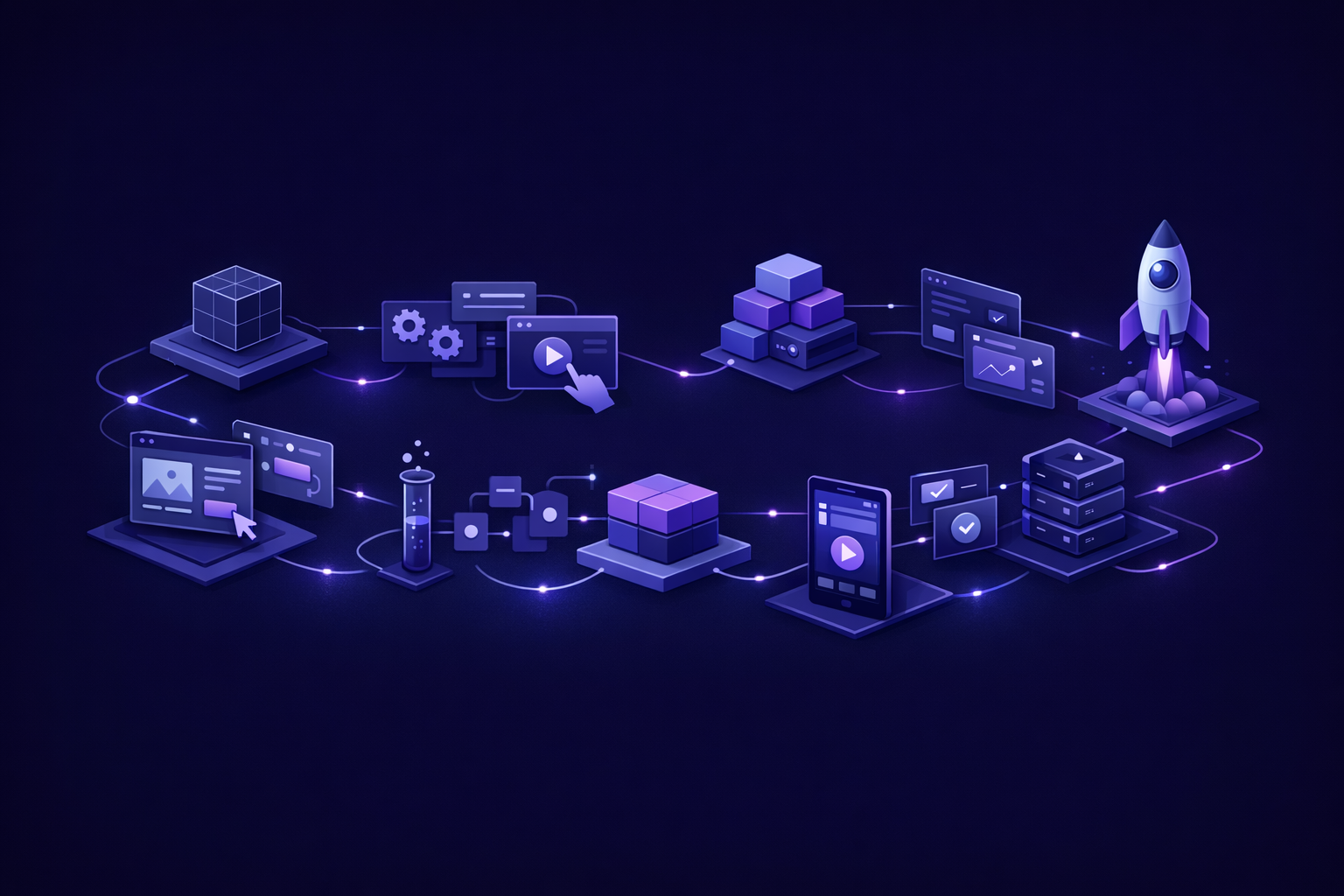
An MVP is the right first step when the core concept is clear enough and the next test requires real usage. This is where many founders underestimate the difference between a demo and a product.
A real MVP usually needs:
- Authentication and user accounts
- A database with the right data model
- Core create, read, update, and delete flows
- Basic admin visibility
- Transactional email
- Deployment to a real environment
- Error handling for obvious failure cases
- A clear path to payment, if monetization is part of the test
Our typical production stack for this is Next.js, React, Supabase, Stripe, Tailwind, Resend, and Vercel. Supabase covers auth and database foundations; the official Supabase Auth docs are a good reference for what real authentication involves. If the MVP includes subscriptions, Stripe is usually the right foundation; the Stripe subscriptions documentation shows why billing is not just a button on a page.
At Build My App Fast, the $5,000 Real app tier is for a full app with logins and a database, delivered in 4–6 days. The $10,000 Launchable MVP tier is for an advanced MVP with subscriptions, integrations, or AI features, delivered in 7–10 days.
That does not mean every founder should jump to a $10,000 build. It means the build should match the question. If the next learning requires real accounts, real data, and real usage, a prototype will not answer it.
For a deeper timeline breakdown, see How Long to Build an MVP? A Realistic Timeline. For budget planning, see MVP Cost 2026: Real Breakdown.
The founder decision checklist
Use this checklist before deciding what to buy or build:
- Can I state the riskiest assumption in one sentence?
- Is the risk technical, behavioral, commercial, or operational?
- Do I need code, screens, or a real product to test it?
- Will the result change my next decision?
- Am I avoiding production work because I am not ready, or because I genuinely do not need it yet?
- Am I asking a prototype to prove something only an MVP can prove?
- Am I asking an MVP to solve confusion that a cheaper prototype could clarify?
If you cannot complete the first two items, pause. The right next step is probably not development. It is clearer thinking, customer conversations, and sharper scope.
The common trap: building a demo and calling it an MVP
A polished demo can be useful for fundraising, sales conversations, and internal alignment. But it is not the same as an MVP.
A demo can fake states. An MVP has to handle them.
A demo can assume the happy path. An MVP has to deal with forgotten passwords, duplicate records, failed payments, empty dashboards, invalid inputs, and users doing things out of order.
This is also where many AI-generated or vibe-coded projects fall apart. They can produce something that looks impressive in a local environment, but the hard parts show up when real users, real data, and real payment states arrive. If you are considering that route, read Vibe Coding Problems Production Exposes before treating a generated prototype as a finished product.
The issue is not that fast tools are bad. We use AI-assisted workflows too. The issue is that someone still has to know what production-ready means. That usually comes from having built and maintained apps before the current AI wave.
How we scope this in practice
When a founder comes to us, we try to avoid selling the biggest possible build. The better question is: what is the smallest build that answers the next important question without creating throwaway confusion?
A typical scoping conversation looks like this:
- What does the product do in one sentence?
- Who is the first user?
- What action must that user complete?
- What has to be real for the test to matter?
- What can be manual, mocked, or deferred?
- What would make this build successful or unsuccessful?
If the answer depends on feasibility, we recommend a POC. If it depends on flow, we recommend a prototype or front-end exploration. If it depends on real usage, we recommend a production MVP.
The fixed-price model only works when scope is honest. That is why our tiers are simple:
- $1,000 Proof of concept — proof of concept, delivered in 2–4 days
- $5,000 Real app — full app with logins and a database, delivered in 4–6 days
- $10,000 Launchable MVP — advanced MVP with subscriptions, integrations, or AI features, delivered in 7–10 days
Clients own the code. They see working software before final payment. The point is not to make the process sound magical. The point is to reduce the gap between idea and usable software without pretending production concerns do not exist.
FAQ
Is a prototype cheaper than an MVP?
Usually, yes, because a prototype can avoid production backend work. But cheaper is only better if it answers the right question. If you need to test payments, user accounts, saved data, or real usage, a prototype may delay the actual learning.
Can a POC become the final MVP?
Sometimes a small part of it can be reused, especially if the POC was built cleanly. But founders should assume a POC is primarily for learning. Its job is to prove or disprove a technical assumption, not become the full product architecture by accident.
Should I build a prototype before every MVP?
No. If the workflow is obvious and the risk is whether people will use or pay for the product, a prototype may be unnecessary. If the workflow is unclear, a prototype can save time by preventing avoidable product rework.
What should I build first if I have no users yet?
Start with validation before software. Talk to the target customer, test the problem, and define the first painful workflow. After that, choose the smallest build that tests the riskiest assumption: POC for feasibility, prototype for flow, MVP for real usage.
If you want help choosing the right first build, apply for a fixed-price app build.