
Vibe Coding Technical Debt: The Bill Comes Due
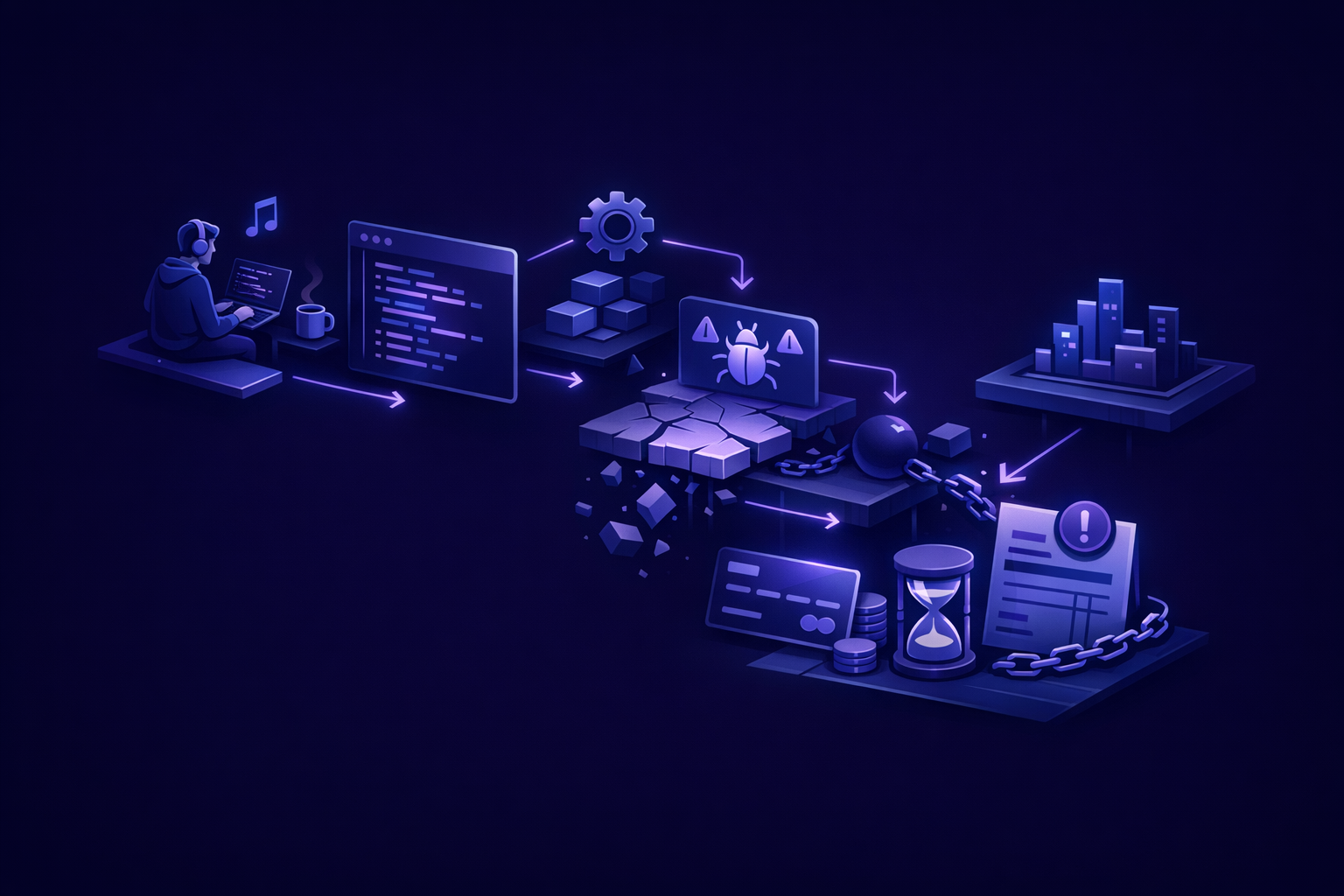
Vibe coding technical debt shows up when a prototype needs auth, payments, security, maintainability, and real users.
Build My App Fast · Aug 15, 2026 · 12 min read
Vibe coding technical debt is the gap between software that appears to work in a demo and software that can survive real users, real data, payments, security rules, and future changes. The bill usually comes due when the founder asks for one more feature, tries to onboard customers, connects Stripe, or needs a developer to fix a bug in code nobody deliberately designed.
Vibe coding can be useful. It can help a founder explore a workflow, create a clickable prototype, or test a rough interface. The problem is treating that prototype as the foundation for a production app without doing the engineering work underneath.
At Build My App Fast, we see the same pattern repeatedly: the UI is farther along than expected, but the data model, auth boundaries, error handling, permissions, and deployment process are not ready. The app looks close. Technically, it is not close.
This post breaks down where the debt hides, how to inspect it, and when it is smarter to rebuild a clean foundation instead of patching generated code until it collapses.
What vibe coding technical debt actually means

Technical debt is not just messy code. It is a future cost created by decisions that made the present easier.
In vibe-coded apps, that usually means:
- Features were added without a stable architecture.
- Components were generated before the data model was understood.
- Auth was bolted on late.
- Database tables were created around screens instead of business rules.
- API routes were copied, regenerated, or duplicated.
- Payments were simulated instead of modeled as real subscription state.
- Errors were handled only enough to satisfy the happy path.
- Security was assumed because the UI hid certain buttons.
That last point matters. Hiding a button is not access control. If a user can call an endpoint directly, or read rows they should not see, the app has a security problem even if the interface looks correct.
This is why our production builds are structured around boring, proven tools: Next.js, React, Supabase, Stripe, Tailwind, Resend, and Vercel. We are not trying to win a novelty contest. We are trying to ship apps that a founder can own, operate, and extend.
If you are still choosing the foundation, our breakdown of the best SaaS tech stack for 2026 explains why this stack works well for fast MVPs without boxing you into a toy architecture.
Where vibe coding technical debt hides
The dangerous thing about vibe coding technical debt is that it rarely announces itself early. The homepage loads. The form submits. The dashboard shows rows. The founder feels close to launch.
Then the hidden parts get tested.
| Debt area | What it looks like in a demo | What breaks in production |
|---|---|---|
| Authentication | Login screen works | Password resets, sessions, roles, redirects, and protected routes are inconsistent |
| Database design | Tables store the visible form fields | Relationships, ownership, constraints, and migrations are unclear |
| Permissions | Admin buttons are hidden | Users can still access data or actions through direct requests |
| Payments | Stripe checkout opens | Subscription state, cancellations, invoices, webhooks, and access control are incomplete |
| AI features | Prompt returns a result | Costs, latency, retries, hallucinations, moderation, and audit trails are unmanaged |
| Error handling | Happy path works | Failed payments, duplicate submissions, and network errors create bad data |
| Deployment | Preview works locally | Environment variables, builds, redirects, and production secrets are fragile |
| Maintainability | Code exists | Nobody can safely change it without breaking unrelated screens |
The common thread is that a generated app often optimizes for visible progress. Production software requires invisible correctness.
The most expensive debt is usually data debt
Bad UI code can be refactored. Bad data models are harder.
If the database was created one screen at a time, you may end up with tables that reflect the first prototype instead of the actual product. Common examples:
- A
userstable duplicated outside the auth system with no reliable relationship to authenticated users. - Customer, account, workspace, and team concepts mixed together.
- Subscription fields stored directly on a user record, even though billing belongs to an organization or workspace.
- Status values stored as loose text with no consistent lifecycle.
- No timestamps, ownership columns, or audit trail.
- No clear migration path when the schema changes.
These problems surface when you add the second or third real feature. The first workflow may work. The next workflow needs a relationship the database cannot express cleanly.
That is when founders discover the uncomfortable truth: the app was not built around the business model. It was built around the first prompt.
A production MVP does not need an enterprise schema. It does need a clear one. For a typical SaaS app, we want to know:
- Who owns each record?
- Can users belong to teams or workspaces?
- What roles exist?
- What states can each core object move through?
- Which events need to be stored for billing, support, or auditability?
- What happens if a user deletes, cancels, or downgrades?
Answering those questions early prevents expensive rewrites later.
Security debt is not optional
Security debt is where vibe-coded apps can become actively dangerous.
AI tools are good at producing plausible code. They are not a substitute for a security model. An app that reads and writes customer data needs server-side authorization, safe secrets handling, and database policies that match the product rules.
If you use Supabase, Row Level Security is a major part of that model. Supabase’s own documentation is clear that tables exposed through APIs should use policies to control access. The official Supabase Row Level Security docs are worth reading if your app stores user-owned data.
Security problems we look for in vibe-coded projects include:
- Service role keys exposed to the browser.
- API routes that trust user-provided IDs.
- Missing ownership checks before reads or updates.
- Admin logic implemented only in the frontend.
- Uploads without file type, size, or permission checks.
- Webhooks without signature verification.
- Overbroad database policies added to “make it work.”
The OWASP Top 10 is still a useful reference point for common web application risks, especially broken access control. See the official OWASP Top 10 if you want the broader security context.
For a deeper founder-level look at this problem, read our post on AI coding security risks.
Payment debt shows up at launch
Stripe integration is one of the clearest places where demo software and production software diverge.
A checkout button is not a billing system.
A real subscription flow usually needs:
- Checkout sessions or customer portal setup.
- Products and prices configured correctly.
- Webhook handling for subscription lifecycle events.
- A database table that stores the customer and subscription relationship.
- Access control based on current subscription state.
- Handling for cancellations, failed payments, renewals, and plan changes.
- A way to test locally and safely deploy production keys.
The most common vibe-coded mistake is assuming payment success at the moment the user returns from checkout. In production, Stripe webhooks are the source of truth for many billing events. If the app does not model that correctly, users may get access they should not have, or lose access when they should not.
This kind of debt is painful because it affects revenue and customer trust. It is also why our $10,000 “Launchable MVP” tier exists: advanced MVPs with subscriptions, integrations, or AI features need more than a pretty interface. They need the operational pieces that let the business run.
When to repair vs rebuild
Not every vibe-coded app needs to be thrown away. Some are useful starting points. The question is whether the existing code saves time or creates more risk.
Here is the practical decision framework we use.
Repair the existing code when
- The app is mostly frontend.
- The database is simple and easy to understand.
- Auth is already implemented with a reliable provider.
- There are few or no payment flows.
- The codebase has a consistent structure.
- You only need a short-lived prototype or internal tool.
Rebuild the foundation when
- Users have accounts and private data.
- The app needs team, role, or workspace permissions.
- Stripe subscriptions control access.
- AI features need logging, limits, or retries.
- The database schema is unclear or duplicated.
- API routes trust client-side state.
- The app will be maintained after launch.
A rebuild sounds slower, but it is often faster than trying to debug a fragile codebase without a coherent architecture. The expensive path is spending two weeks patching generated code, then rebuilding anyway.
If you already have a generated prototype and want to understand the path forward, our guide on how to move vibe code to production covers the transition in more detail.
A founder’s audit checklist
Before you ask a developer to “just clean it up,” inspect the app against this checklist. You do not need to be deeply technical to ask these questions.
- Can you explain the core database tables in plain English?
- Does every private record have a clear owner?
- Are protected routes enforced on the server, not only in the UI?
- Are API routes checking the authenticated user before reading or writing data?
- Are secrets stored only in server-side environment variables?
- Are Supabase RLS policies enabled and intentionally written?
- Are Stripe webhooks implemented and verified if payments exist?
- Are errors shown to users in a helpful way?
- Can the app be deployed cleanly to Vercel from a fresh clone?
- Is there a simple README explaining setup, environment variables, and key flows?
- Can a developer add a feature without asking the AI to rewrite large parts of the app?
- Do you know which parts are prototype-only and which are production-ready?
If you cannot check most of these boxes, the app may still be useful as product discovery, but it should not be treated as launch-ready software.
How we remove the debt in a fast build
Our process is not mysterious. We make the important decisions deliberately, then build quickly on a stable stack.
For a typical app, we start by reducing the scope. Most MVPs do not need ten features. They need the few workflows that prove the business case. Our post on how to scope an MVP so it ships in under 2 weeks is a useful companion if your feature list keeps expanding.
Then we define the technical foundation:
- User flows: signup, onboarding, core action, payment or conversion, admin/support needs.
- Data model: tables, relationships, ownership, statuses, and lifecycle events.
- Auth and permissions: Supabase Auth, protected routes, RLS policies, and server checks.
- UI implementation: React components, Tailwind styling, form validation, loading states, and error states.
- Integrations: Stripe, Resend, AI APIs, external services, and webhook handling.
- Deployment: Vercel setup, environment variables, production build, and handoff documentation.
This is why fixed scope matters. A fixed-price build only works when the deliverable is clear. Our tiers are intentionally simple:
- $1,000 “Proof of concept” — proof of concept, delivered in 2–4 days
- $5,000 “Real app” — full app with logins and a database, delivered in 4–6 days
- $10,000 “Launchable MVP” — advanced MVP with subscriptions, integrations, or AI features, delivered in 7–10 days
The client owns the full codebase. The timeline is fixed. The price is fixed. And the client sees working software before final payment.
That last part matters because it aligns incentives. We are not billing hours while the scope drifts. We are shipping a defined product that has to work.
Vibe coding is not the enemy. Unowned code is.
The point is not that founders should avoid AI tools. AI-assisted development is here, and used well, it can speed up parts of the process.
The issue is ownership.
If nobody understands the architecture, nobody owns the risk. If nobody can explain the permission model, nobody owns security. If nobody knows how billing state changes, nobody owns revenue access. If every change requires another broad prompt, the codebase is not a product asset. It is a pile of generated guesses.
Good software does not have to be overbuilt. In fact, an MVP should be small. But small and sloppy are different things.
A strong MVP has:
- A narrow scope.
- A clear data model.
- Real authentication.
- Server-side authorization.
- Production deployment.
- Maintainable code.
- Enough documentation for the next developer.
That is the difference between a prototype and a product.
FAQ
Is vibe coding technical debt always bad?
No. Debt is acceptable when it is intentional and temporary. A quick prototype can help you learn what users want before investing in a real build. The problem is forgetting which parts are temporary and trying to launch them as production infrastructure.
Can a developer clean up my vibe-coded app?
Sometimes. If the app has a reasonable structure and limited backend complexity, cleanup may be worthwhile. If auth, permissions, payments, and database design are inconsistent, a rebuild is often cheaper and safer than patching.
How do I know if my vibe-coded app is production-ready?
Test the non-demo paths: password resets, unauthorized access, failed payments, duplicate submissions, empty states, webhook events, mobile layouts, and deployment from a fresh environment. If those fail, the app is not production-ready yet.
Should I use vibe coding before hiring developers?
It can be useful for product exploration. Use it to clarify screens, workflows, and copy. But before real customers and real data enter the system, have an engineer review or rebuild the foundation.
The bill is avoidable if you catch it early
Vibe coding technical debt becomes expensive when founders mistake visual progress for engineering progress. If you treat generated code as a sketch, it can be useful. If you treat it as the production foundation without review, the hidden bill arrives later through bugs, security gaps, payment issues, and slow feature work.
The best time to address the debt is before launch, not after customers are depending on the app.
If you want a fixed-price team to turn your prototype or idea into a production-ready app, apply to Build My App Fast.